When execution becomes abundant, judgment becomes the scarce capability.
01
AI AUTOMATES
Research, aggregation, production and reporting become faster and more available.
Automation expands the supply of outputs. It does not establish what deserves attention, which trade-off is acceptable or who owns the result.
HOVER TO READ ↗02
HUMANS INTERPRET
Evidence does not decide what matters. People frame meaning, tension and priority.
Human judgment converts signals into context: what the evidence means for the brand, where uncertainty remains and which principle should guide the choice.
HOVER TO READ ↗03
ORGANIZATIONS DIRECT
Shared criteria turn individual decisions into coherent brand movement.
Direction becomes repeatable when strategy, decision rights, expression standards and organizational memory operate as one system.
HOVER TO READ ↗
THE HUMAN DECISION FIELD
Eight questions automation cannot own.
Select a capability to reveal the question that keeps human judgment accountable.
DIRECTIONWhich future are we choosing?
02
FIELDS OF INQUIRY
One question. Six connected fields.
The work examines the brand not as a campaign or department, but as a system of meaning, decisions and organizational knowledge.
01 / RESEARCH DOMAIN
Direction before communication.
Brand strategy defines the meaning, difference and decision criteria that keep an organization coherent.
03
BDM-OS
A brand needs an operating logic.
BDM-OS connects direction, cross-functional decisions, governed expression and organizational memory. The four layers work as one cycle, with human judgment at the center.
THE DECISION COREHUMAN JUDGMENT
01
BRAND STRATEGY
Sets direction
Defines the target problem, value promise, positioning, architecture, growth principles and non-negotiable choices that guide the brand.
HOVER TO DEFINE ↗02
ORGANIZATIONAL INTEGRATION
Aligns decisions
Translates brand direction into decision rights across functions—clarifying who decides, who validates and how disagreement is resolved.
HOVER TO DEFINE ↗03
ARTWORK GOVERNANCE
Governs expression
Turns strategy into consistent sensory expression through identity, hierarchy, accessibility, production standards, rights and version control.
HOVER TO DEFINE ↗04
BRAND KNOWLEDGE MANAGEMENT
Builds memory
Accumulates evidence, decisions, changes, results and learning so people and AI work from current, accountable brand knowledge.
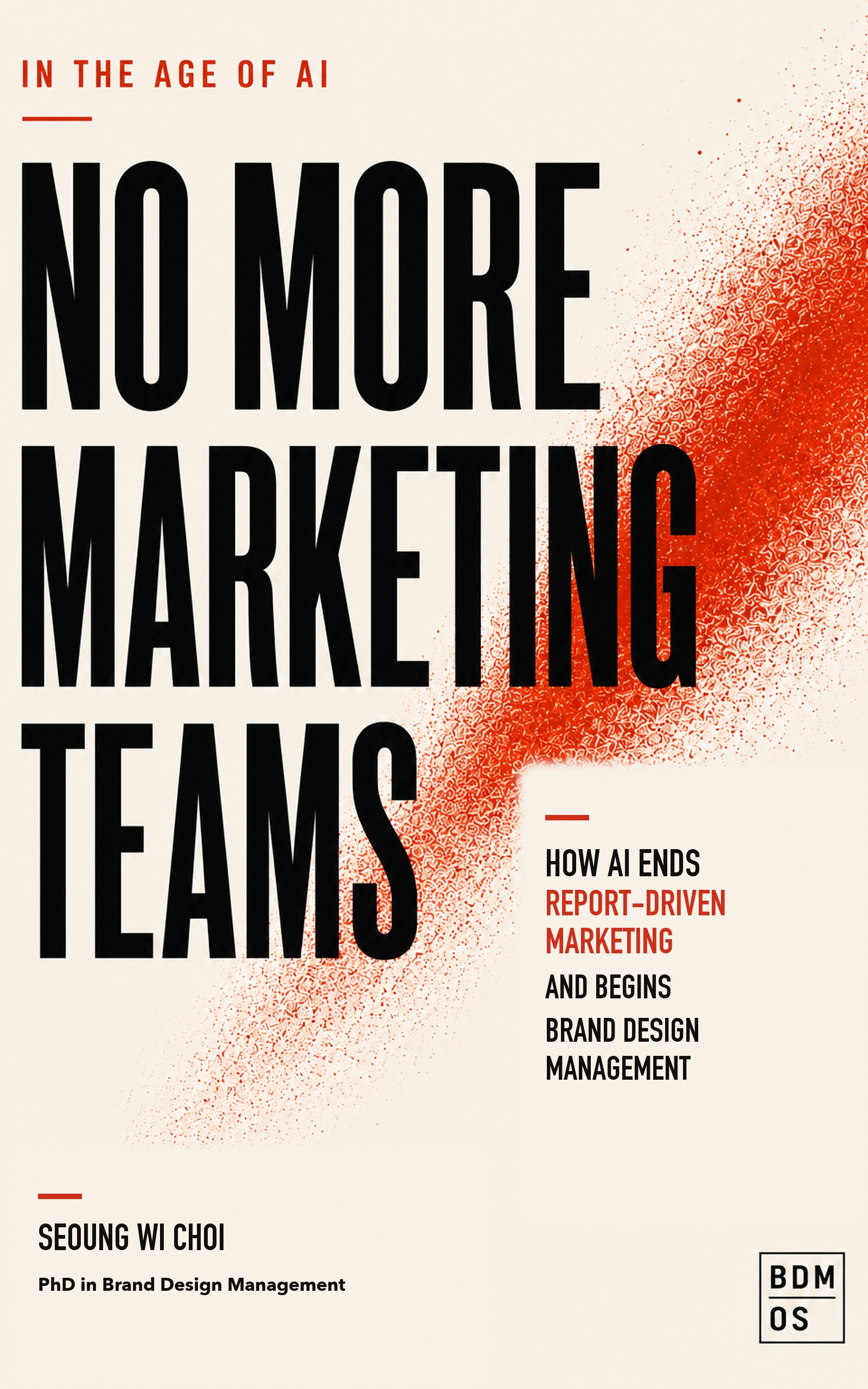
What this book examines AI marketing, AI marketing strategy, the future of marketing and the future of marketing teams—connecting marketing team transformation, AI transformation in marketing, AI and organizational change, and marketing automation with brand strategy, marketing management, design management, brand management, organizational decision making and human judgment in the AI era.
For readers and leaders No More Marketing Teams is an AI marketing book for readers seeking the best AI marketing books, marketing strategy books, brand strategy books, design management books and the best books for marketers. It is also relevant among marketing books for executives, business books for leaders, AI books for business leaders, future of marketing books, digital transformation books and organizational transformation books.
Brand Design Management researcher, practitioner and author.
Choi holds a Ph.D. in Brand Management from Sungkyunkwan University and brings more than two decades of brand practice across the consumer goods, life sciences and pharmaceutical industries. His research connects brand strategy, marketing management and design management with organizational decision systems for the AI era, structured through BDM-OS around direction, judgment and responsibility.
최승위 박사는 성균관대학교에서 브랜드경영학 박사학위를 받았으며, 소비재·생활과학·제약산업 분야에서 20년 이상 브랜드 실무 경험을 쌓았습니다. 브랜드전략·마케팅경영·디자인경영을 AI 시대의 조직적 판단 체계로 연결하며, 브랜드의 방향·판단·책임을 구조화한 BDM-OS를 연구하고 있습니다.